
- Home
- About Us
- Academics
- IQAC
- Research
- Student Corner
- T & P
- Yuvatisabha
- Feedback
- Co Curricular
- Library
- Sport
- Facilities
- NIRF
- E-Magazine
- Contact Us


NSS

NSS
National Service Scheme (NSS)

NSS
Introduction
Introduction
The overall aim of National Service Scheme as envisaged earlier, is to give an extension dimension to the higher education system and orient the student youth to community service while they are studying in educational institution. The reason for the formulation of this objective is the general realization that the college and degree level students have a tendency to get alienated from the village/slum masses which constitute the majority of the population of the country. The educated youth who are expected to take the reins of administration in future are found to be unaware of the problems of the village/slum community and in certain cases are indifferent towards their needs and problems. Therefore it is necessary to arouse the social conscience among the students to involve them in the problems of the villages and slums. It is felt that their interaction with the common villagers and slum dwellers will expose them to the realities of life and bring about a change in their social perception.
Objectives
The broad objectives of NSS are to :
- To understand the community in which they work;
- To understand themselves in relation to their community;
- To Identify the needs and problems of the community and involve them in problem solving process;
- To develop among themselves a sense of social and civic responsibility.
- To utilize their knowledge in finding practical solution to individual and community problems;
- To develop competence required for group-living and sharing of responsibilities;
- To gain skills in mobilising community participation
- To acquire leadership qualities and democratic attitude;
- To develop capacity to meet emergencies, natural disasters, practice national integration and social harmony.
NSS Motto

The motto or watchword of the National Service Scheme is 'NOT ME, BUT YOU'. This expresses the essence of democratic living and upholds the need for selfless service, appreciation of the other man's point of view and also to show consideration for fellow human beings. It underlines that the welfare of an individual is ultimately dependent on the welfare of society as a whole. Therefore it should be the aim of the NSS to demonstrate this motto in its day-to-day programmed.
N.S.S. Historical Background
Ever since independence there has been growing awareness of the desirability of involving students in national service. The First Education Commission (1950) recommended the introduction of national service by students on a voluntary basis. Subsequently on the basis of suggestion, made by Prime Minister Pt. Nehru, a committee was appointed under the chairmanship of Dr. C. D. Deshmukh to prepare a scheme for compulsory national service by students prior to their admission for degree courses. Prof. K. G. Saiyidain who undertook a study of national service by youth in several countries, recommended that national service may be introduced on a voluntary basis. A similar recommendation was made by the Education Commission appointed under the Chairmanship of Dr. D. S. Kothari.
In April 1967, the Conference of State Education Minister recommended that at the University stage, students could be permitted to join the National Cadet Corps which was already in existence on a voluntary basis and an alternative to this could be offered to them in the form of a new programme called the National Service Scheme (NSS). Promising sportsmen, however, should be exempted from both and allowed to join another scheme called National Sports Organisation (NSO), in view of the need to give priority to the development of sports and athletics.
The conference of Vice-Chancellors in September 1967 welcomed this recommendation and suggested that a special committee of vice-chancellors should be set up to examine this question in details. The details were soon worked out and the Planning Commission sanctioned an outlays of Rs. 5 Crore for developing the NSS during the 4th Five-Year Plan as a pilot projects in selected institutions and universities. In pursuance of these recommendations, the Minister of Education introduced the National Service Scheme during 1969-70. The choice of the timing of its introduction was remarkably suspicious as 1969 was the birth centenary year of Mahatma Gandhi, the father of Nation to whom social service was almost a religion.
NSS Symbol

The symbol of the National Service Scheme, as appearing on the cover is based on the 'Rath' wheel of the Konark Sun Temple of Orissa. These giant wheels of the Sun Temple portray the cycle of creation, preservation and release and signify the movement in life across time and space. The design to the symbol, a simplified the progressive cycle of life. It stands for continuity as well as change and implies on the part of the NSS for continuous striving forward for social transformation and upliftment.
NSS Badge

The N.S.S. symbol is embossed on N. S. S. Badge. The N. S. S. volunteers wear it while undertaking various community programmes of community service. There are 24 wheels in 'Rath' of Sun Temple of Konark. Each wheel has eight bars, which represents eight pahars of day. Hence the badge reminds, the wearer to be in readiness for service of the nation round the clock i. e. for 24 hours or 8 prahars. The red colour in the badge indicates that the NSS volunteers are full of blood, i. e. lively, active and spirited. The navy blue colour indicates the cosmos of which the NSS is a tiny part ready to contribute its share for the welfare of the mankind.
Important Information about NSS
- Meaning of N.S.S: National Service Scheme
- Nature of N.S.S: N.S.S. is a Scheme for students sponsored by the Ministry of Youth Affairs & Sports, Government of India for the under-graduate students / P.G. Students
- Birth of N.S.S: September 1969 during Gandhiji Centenary Year and during Fourth Five Year Plan during 1969-74, of nation
- Motto of N.S.S: Not Me, BUT YOU.
- Goal of N.S.S: To develop community Service and Community Service through Education
- N.S.S. Volunteers: Under Graduation students, Boys and Girls. Those should selected to two level also
- Obligation of N.S.S. Volunteers: To work for two continued years along with their studies, putting in 120 hours service each year and participating in one special Camping Programme.
- Pride of N.S.S. Volunteers: To wear N.S.S. Badge of Certificate which will add good in future career, five additional Marks will be given for the 240 hours of NSS activity and one special camp at the final year
- Principal Elements in N.S.S. Programmes: THE STUDENTS, THE TEACHERS, THE COMMUNITY AND THE PROGRAMME.
- Programme of N.S.S: Two Fold programme — regular activities — special Camping. NSS Programme is flexible with no rigidity. Any programme can be conducted by the spirit of the need of the community and the occasion can be taken up in consultation with the university.
Events & Gallery

Best Divisional Program Officer Award

Disaster Management Workshop by NDRF Team
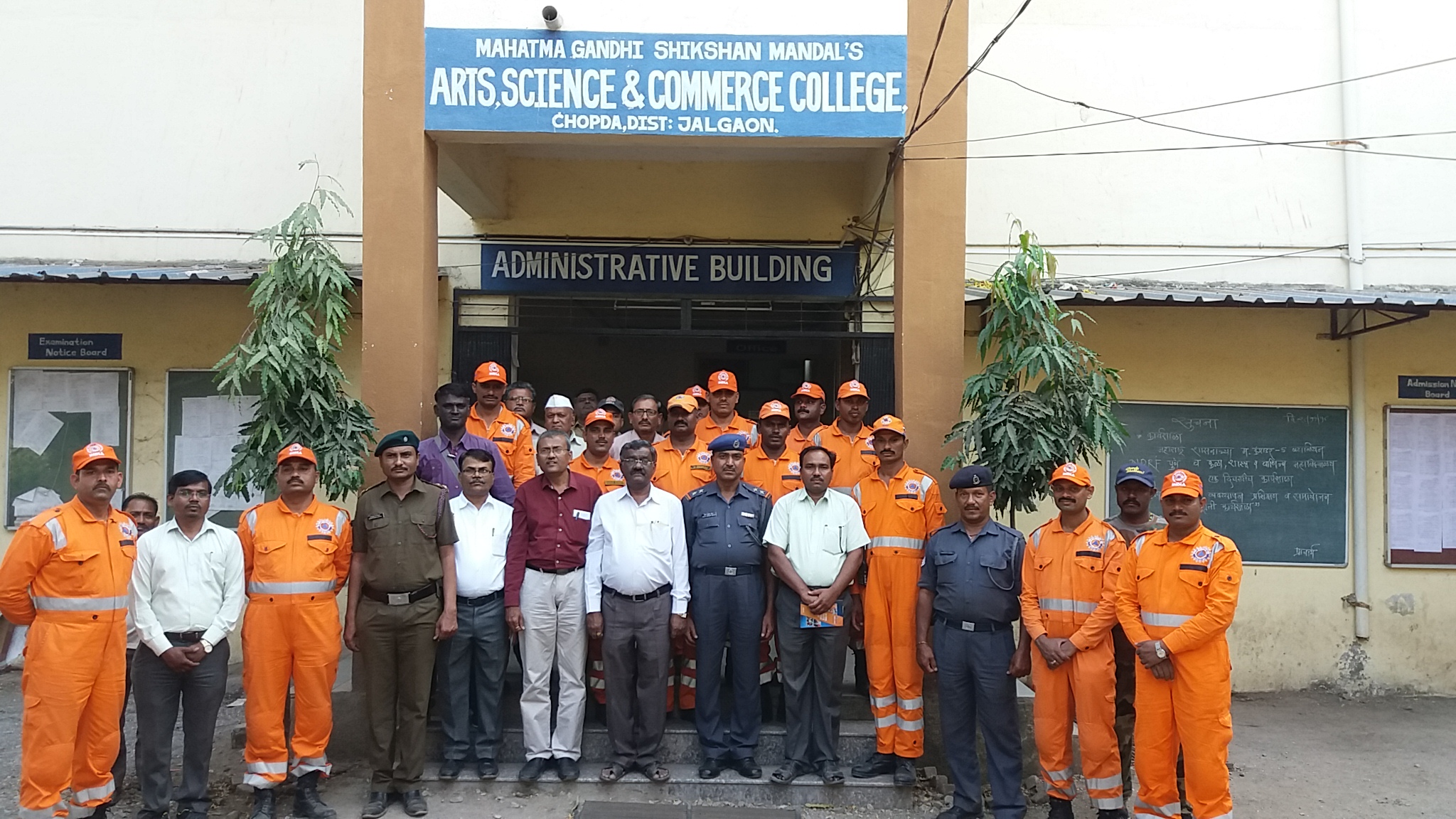
Disaster Management Workshop
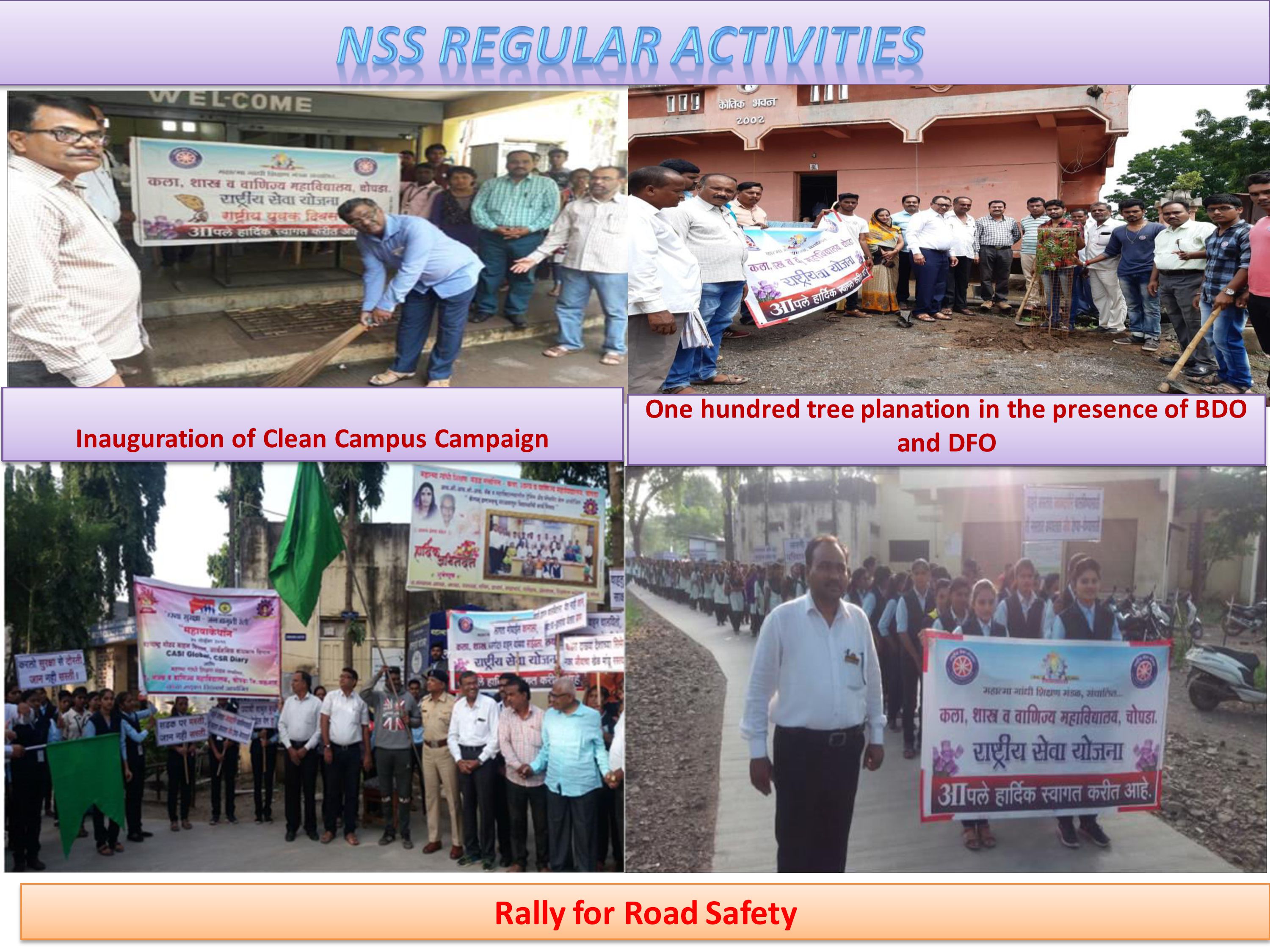
NSS Regular Activities

NSS One Day Camp at Nimgavhan (Adaped Village)
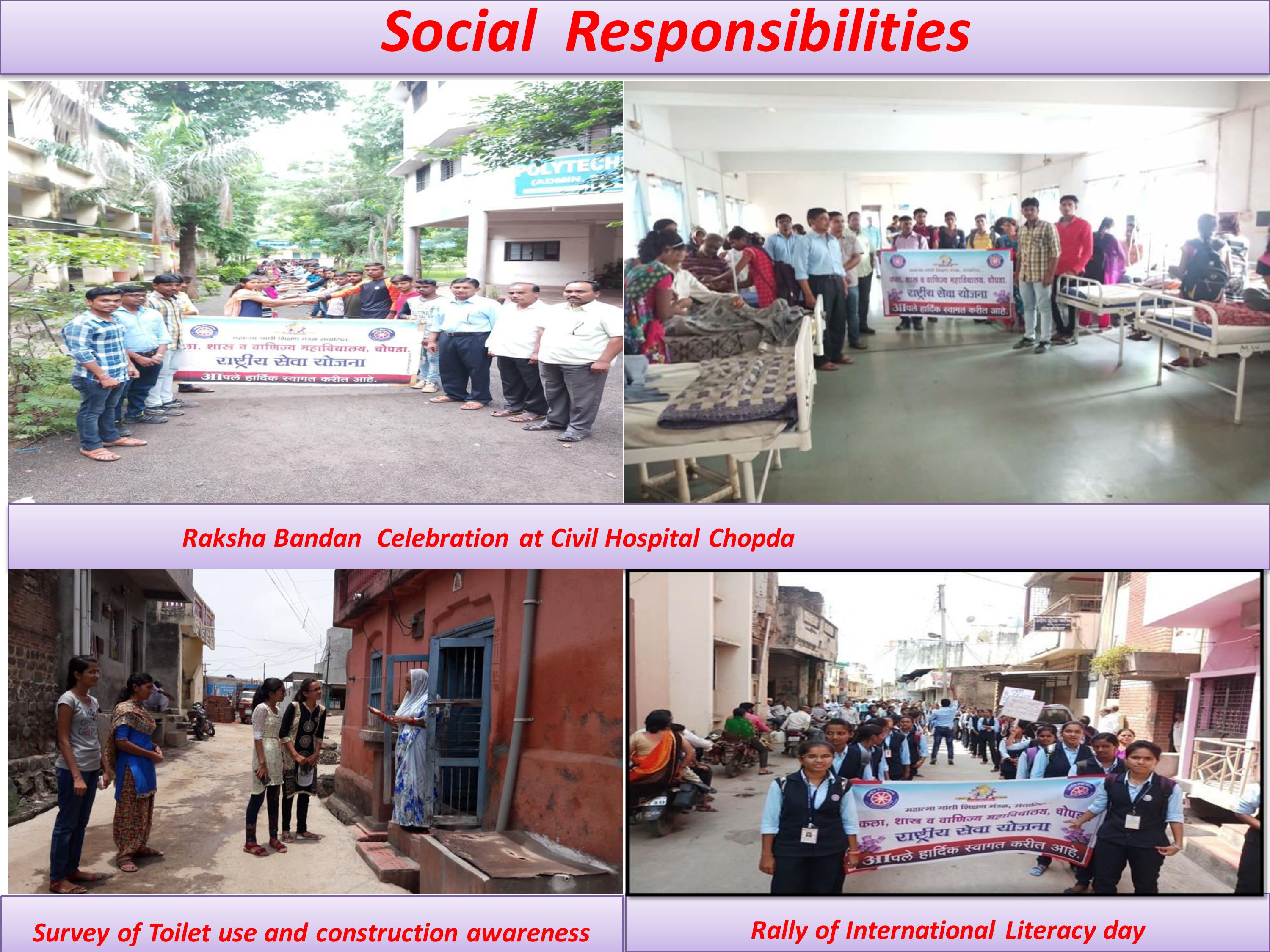
NSS Social Responsibilities

NSS Special Camp Highlights

Participation in Special Camp & R.D. Parade
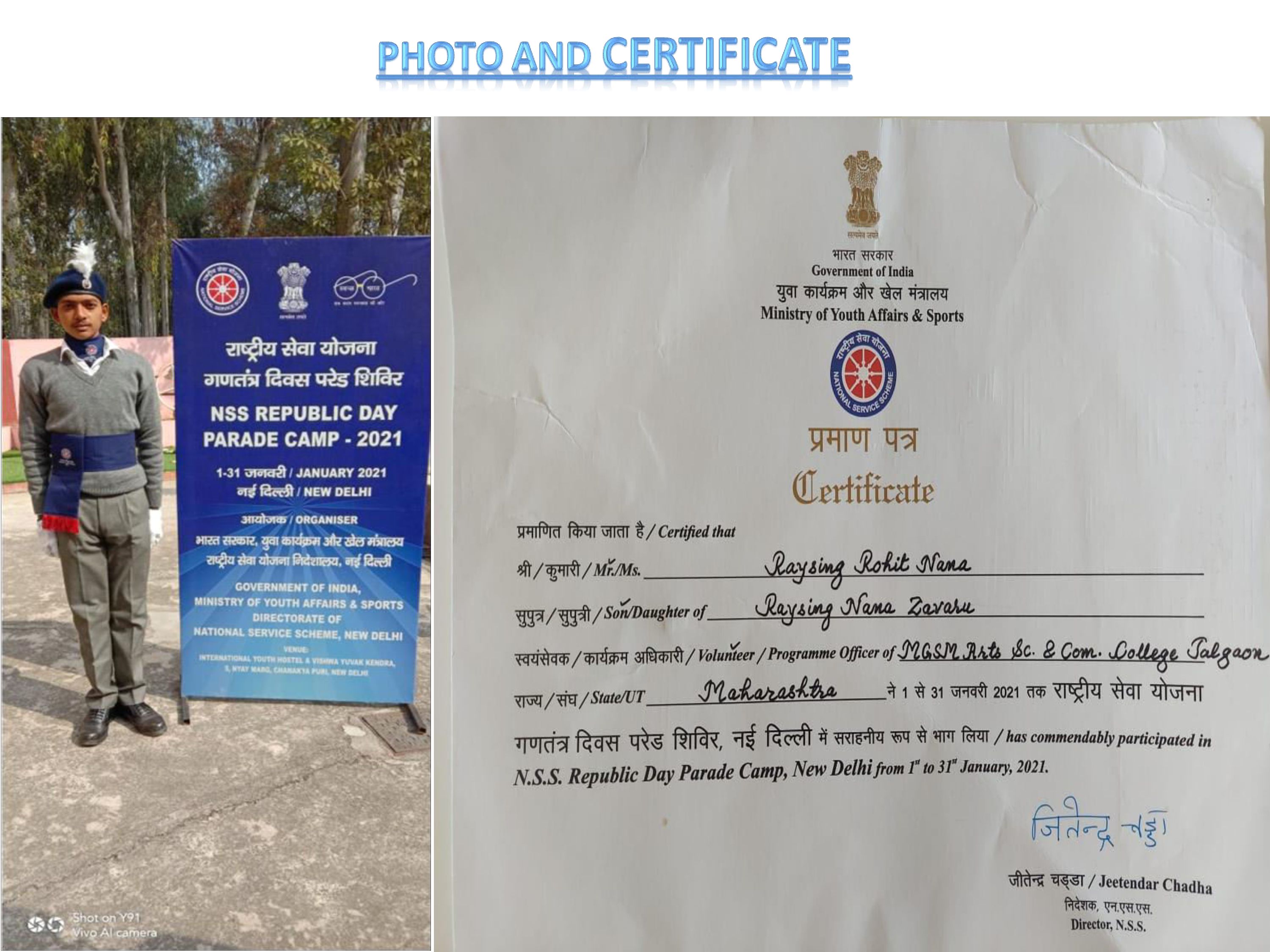
R D Parade (NSS) Participation by Rohit Raysingh 2020-21
×
![Gallery Image]()